
Based in Rotterdam, Sabine Marcelis credits growing up in New Zealand and time spent on the slopes for her instinctive sensitivity to light, or what she calls, “picking up where the sun left off”. The designer’s exploration of light and its relationship with resin, stone, and glass is instantly recognisable, expressed through sunset and sunrise palettes that shift between tone-on-tone and gradient effects across objects and installations.
Marcelis timed her visit to Australia with the opening of the monumental Cartier exhibition, designed in collaboration with fellow Rotterdam-based multidisciplinary studio CLOUD. In this interview, she reflects on presenting more than 400 jewels and objects within ‘distinct worlds’, the role of light and architecture in guiding visitors through the experience, and “blowing up” gemstones through colour, material and scale.
Coinciding with her solo exhibition, AXIS, at Sally Dan-Cuthbert Gallery, Marcelis shares how this body of work is unlike anything she has created before as she continues to unpick the possibilities for production. Marcelis recalls her residency in Japan, where she worked with artisans on centuries-old lacquerware techniques, and how these lacquer works contrast and interact with new resin pieces.
Recent experiments with resin culminate in Plume, first unveiled at Salone Raritas, where Marcelis speaks about ‘designing the bubble’ and the role of collectable design in pushing her practice forward.
AXIS is on display from 20 June to 1 August 2026.
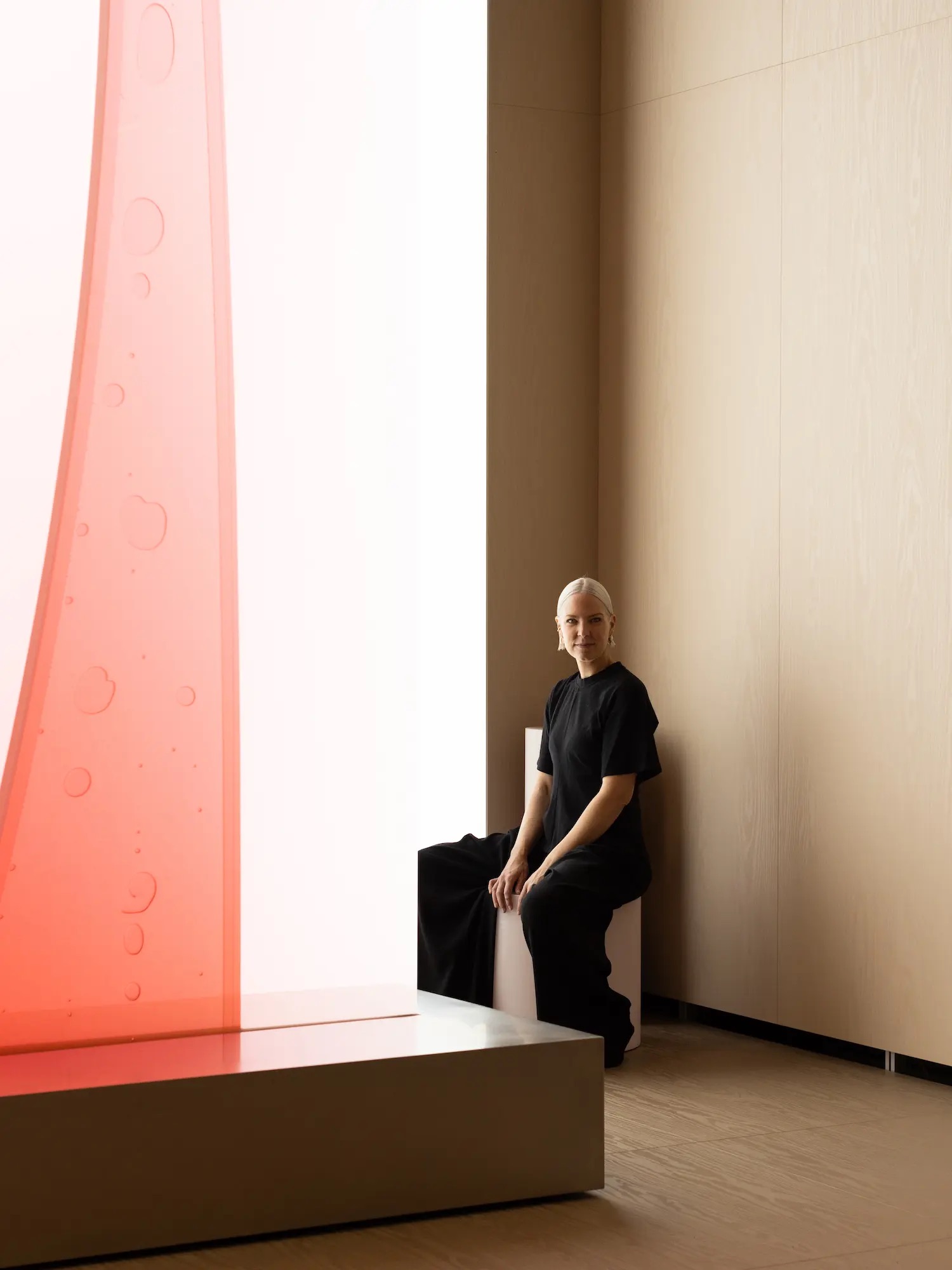
Congratulations on your collaboration with the NGV for the Cartier exhibition. Working with CLOUD, you’ve created large-scale sculptures that help guide visitors through the exhibition while enhancing the experience of Cartier’s extraordinary collection. What was the conceptual basis for these works?
Sabine Marcelis: I think with any project you’re involved in, whether it’s with a brand, a museum, or anywhere different worlds need to come together, it’s nice to pick up on commonalities.
Obviously, the way a gemstone is experienced is because of how light reflects off it, and I wanted to zoom in on that effect and blow it up into a more experiential installation that guides you, or welcomes you into the exhibition, but then also bookends it at the end as a final closure to the exhibition again. Having this single horizontal piece with just one cut through it produces these reflections. Then, because colour is so important in the show, with all these separate rooms and colours, I wanted to combine them into a cohesive palette across those works as well.
Wielding light—both natural and artificial—is something you’re known for, which you’ve often linked to your upbringing in New Zealand and time spent in the mountains. What kind of sensorial experience were you hoping to create for visitors with your works as they moved through the Cartier exhibition?
Sabine Marcelis: We wanted to create different worlds because the show’s narrative has many stories to tell. Sometimes, in a show this big, it can feel a bit repetitive if there’s a single design language throughout.
So we really wanted to create these moments where you’re taken into a different world, then another, and keep it surprising and fresh with every chapter unfolding. Light plays an important role, as some spaces are much darker, more intimate, and dimly lit, while others are much brighter. It’s really about taking you on a journey through light and colour.
The scenography needs to serve the content. It shouldn’t be overwhelming or competing. If anything, it needs to bring the subject matter to the forefront: that’s the purpose of the show. Given that the subject matter here is so small relative to the scale of the spaces, it was vital to create additional architecture within the galleries so that the works would not be lost in these large spaces.
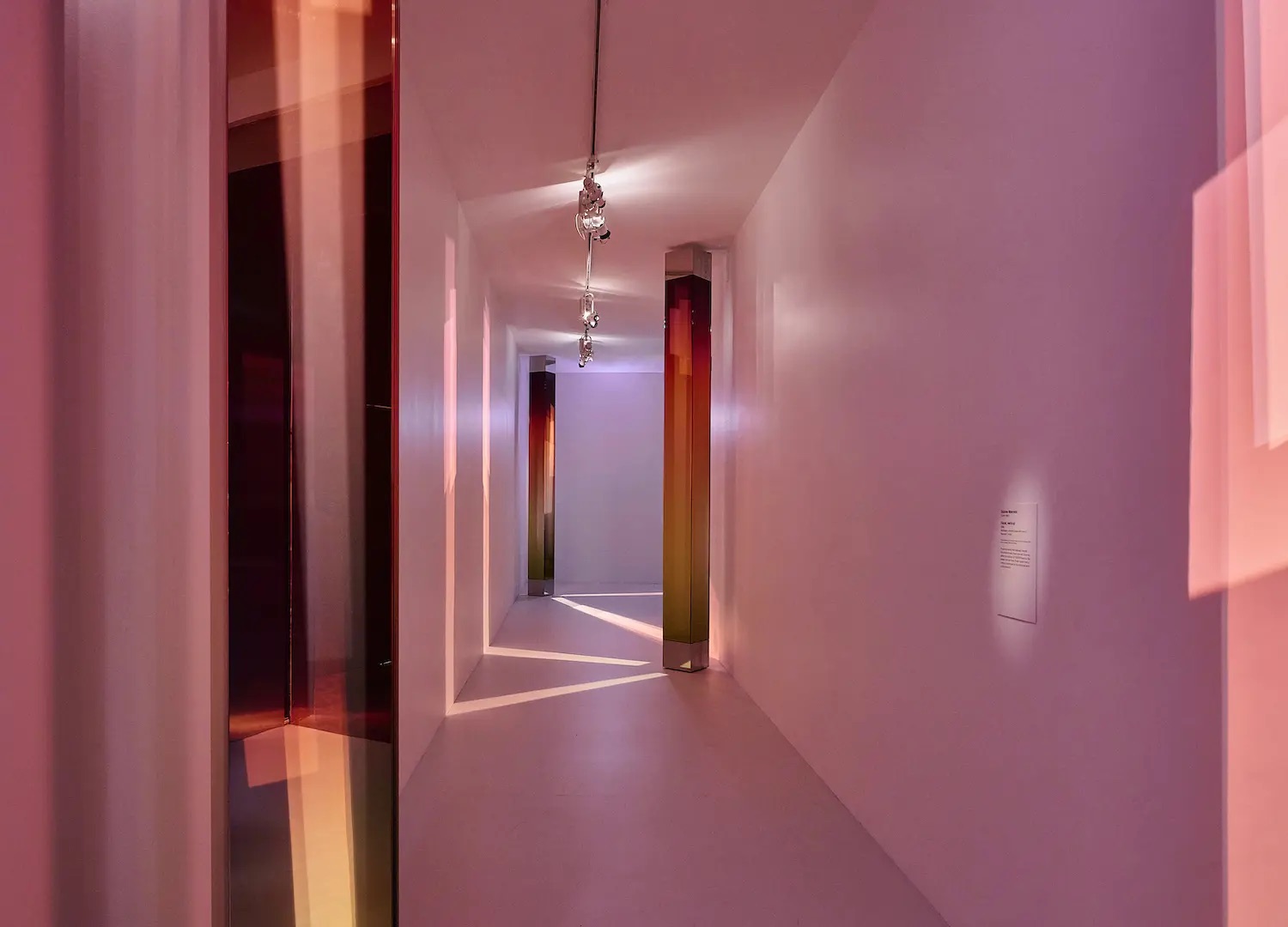
Likewise, transparency, opacity and reflection are recurring themes in your work. How did you approach the jewels’ relationship with light—particularly the way they catch, absorb and reflect it throughout the exhibition?
Sabine Marcelis: In each room, there was a piece that informed the colourway of that room. For example, in the yellow room, it’s the yellow diamond from the Maharaja necklace. In the coral room, it’s the Maria Felix bracelet.
In the burgundy room, it’s the rubies, and so on. The colour is largely defined by those iconic pieces, and the materiality also references them. Many of the textures on these volumes are reflective or highly polished, but their intensities vary.
In the yellow room, we used a polished metal, but it’s not as reflective as the one in the Mystery Clocks room, the grey space. So it’s about playing on those subtleties. The gems are all subtly different as well, even though they all serve to reflect light.
In the Cartier Style room, we actually wanted to give visitors a break from the reflective elements. That’s really more like stepping inside a jewellery box, with this soft velour-like fabric. So it was about creating hierarchy and flow, and change between the rooms through materials as well.
You are interested in how the experience of space can be manipulated through colour. How did you approach the Cartier exhibition as an opportunity to explore colour?
Sabine Marcelis: We spent a lot of time on what the exact colours were going to be. Of course, you’re also thrown curveballs where certain carpets are suddenly unavailable after you’ve spent so long deciding that this is the one you need to use. Then you have to pivot, which means the other colours need to change slightly so everything works together. Sometimes, if the tint of one colour changes, it suddenly no longer works with the one next to it. That’s a balance I’m very sensitive to. It throws everything off.
I like to do the unexpected and use colour and light as carriers of an experience. This felt like the perfect opportunity to do that, and it made so much sense. When you collaborate with a brand, if it feels forced, it doesn’t work. This felt like the opposite. It was so natural and easy. The inspiration was all there. Especially creating the intro and outro rooms: it was basically just blowing up these gemstones and infusing them with that colour palette. It was such a pleasure to work on.
You’ve spoken about the freedom that collectable design pieces offer, beyond commercial constraints and marketing briefs. In this project, how did the complexity of the material development and experimentation push your practice forward?
Sabine Marcelis: I think it’s always a matter of confidence; confidence in the production process. Projects like this show both my team and the wider world what’s possible. Often commissions come from them. People will say, “We love this. Could you make it bigger?” or “Could you adapt it in this way?”Because we’ve already achieved something that felt impossible, I’m confident in saying yes. Hopefully, it means continuing to pursue more projects like that because it’s so easy to become stuck in one way of working. But that’s not creatively fulfilling. I always want to keep surprising people and showing them, “Look, we can do this too.” Or imagine this, but even bigger!
The opening of the Cartier exhibition coincides with AXIS, your latest exhibition with Gallery Sally Dan-Cuthbert, which has represented your work since 2019. How does AXIS build on what you’ve explored in your previous exhibitions with the gallery?
Sabine Marcelis: It’s actually extremely different. With this show, I just wanted to do something completely new again. The past few years have been a bit of a rollercoaster of projects, and I’ve been jumping from one thing to the next. There haven’t been many moments to pause and create a brand-new body of work, so that’s what I really wanted to do with this.
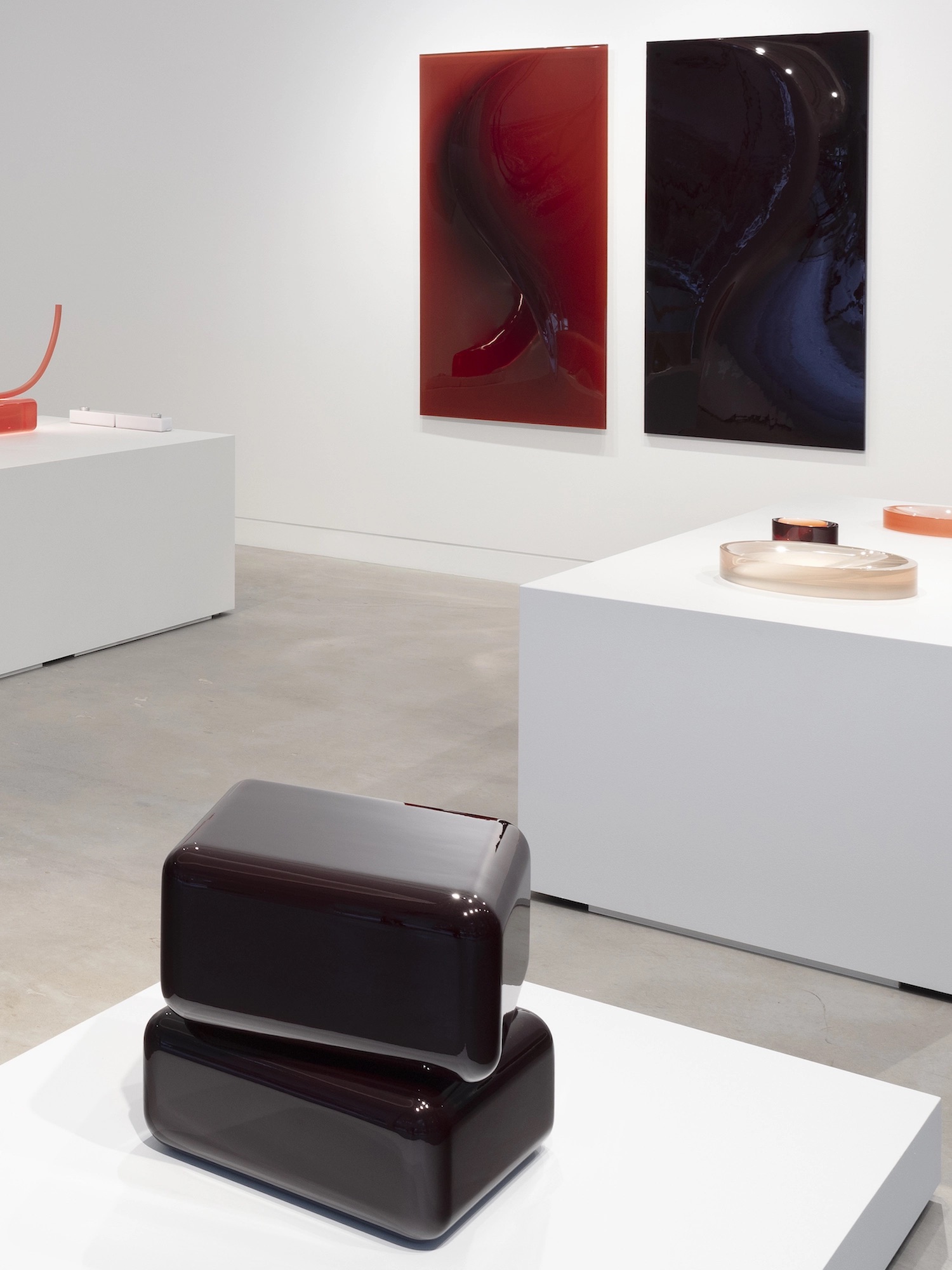
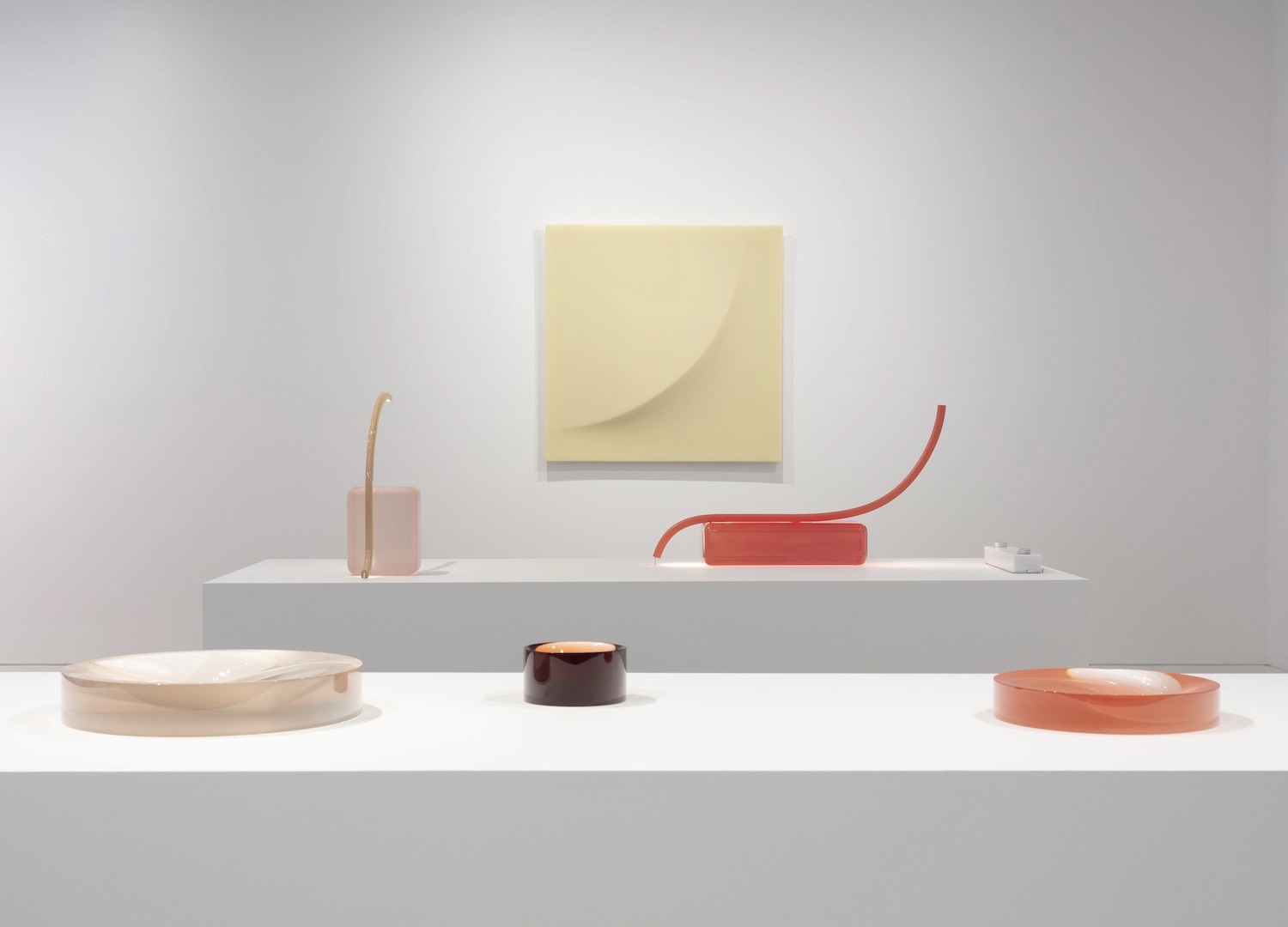
Not all of the resin pieces have a light source, particularly the wall pieces. They are just resin, so they’re more like artworks than designs, since they don’t serve a functional purpose in providing light.
But they still exist through the way they reflect the light around them. There is a single gesture running through them all. It’s like a line that is either going into the material or coming out of the material. Because of that, when you first look at them, they might seem like a flat plane, but as you move around, you suddenly realise there’s this very dynamic form within them.
I’m really excited about these pieces, and I also can’t wait to make even bigger ones. It’s such a simple gesture, but it works so well with light, especially because the surface is highly polished, so it really picks up on everything around it.
The whole premise of the show is also built on a project I did in Japan with lacquerware. That’s really where the idea started: if you can’t work with transparency or the filtering of light, how does an object still become something that very much works with light?
The lacquer works were made possible by Craft x Tech Japan, bringing international designers and local makers together in Japanese design. This led you to the Kawatsura Shikki artisans in Akita, Japan. As a self-professed “production nerd”, what inspired you most from the immersion into these lacquerware traditions and the centuries-old making process?
Sabine Marcelis: It’s true. I love nothing more than being inside a production process and seeing how things are done.
The entire town is built around the craft of lacquerware. The craftsman making the wooden forms has his atelier on the river because, historically, trees were cut down and floated downstream to the woodcarver. Once he had finished his work, the pieces would continue on to the lacquer workshop. I love seeing how the whole structure of a town is built around serving a particular craft.
At the same time, it’s really sad because it’s very much a dying craft. The craftsman I worked with told me that when his father owned the company, there were around 80 employees. Today, they only have nine left. It’s something the next generation isn’t as interested in, and I think it’s also a designer’s responsibility to showcase how amazing these crafts are and bring them to different places around the world. It’s really nice to be able to bring it to Australia and show how special this craft is.
There are these really subtle effects that people might look at and think, “Couldn’t that just be painted?” But it isn’t the same. It ages over time. Especially with the wall pieces, the lacquer at the very tip of the line has faded over the past two years. What emerges is this beautiful white line that gradually fades into the deep colour of the lacquer. I really love that it’s a material that’s alive. It’s not finished and then fixed forever. It’s almost the exact inverse of what happens with the resin.
Did the lacquer works take a different shape than what you first envisioned?
Sabine Marcelis: They pretty much became what I expected them to be. But the ageing process has been really beautiful. There are around 30 layers of lacquer, so it takes a very long time. It’s almost like nail polish––one coat, wait for it to dry, then another coat. It takes weeks to complete these pieces.
At first, they were much darker than I expected. I was actually worried because you could barely see the red undertone. They looked almost black. The craftspeople told me, “Don’t worry, it’s going to fade.” To me, that seemed impossible. I thought, “How can it fade? Isn’t this just what it is?”
But they were right. Now it’s become this really vibrant red undertone, whereas before it was literally black. I think that’s incredibly special in itself. That patience and allowing something to form in that way feels like a lost art.
Being so attuned to light and its impact on materials, can you talk about how the works in AXIS respond differently, and at times in opposition?
Sabine Marcelis: Through that lacquerware project, I became interested in bouncing all the external light off these shapes because the surface is so reflective and highly polished. The exercise became: which forms best serve that purpose?
The two coffee tables I designed have very rounded edges and are pivoted to maximise reflection. Not unlike a gemstone, but instead of sharp cuts, everything is very rounded. The same thing happens with the wall pieces. You have these forms that are almost as if you’ve pressed your finger into cream; this movement that then picks up all the light around it.
I also wanted to showcase what happens when you use similar forms but a different material. There are counterparts in resin, and they really demonstrate how a difference in material and a difference in surface texture completely transform how you experience those same shapes.
Lastly, I was fortunate to see you during Salone Rartias, where you were showcasing Plume – something you had long wanted to do: to fine-tune the movement of an air bubble through a liquid. How long was Plume in material development and prototyping to achieve this precise viscosity of the liquid?
Sabine Marcelis: We basically set up a small lab in the studio with different vats of silicone oil and started making different mixtures. We were also testing airflow intensity because it makes a huge difference. If the liquid is too thick, you get these sad little bubbles. If it’s too thin, like water, the bubbles just move all over the place. So we were essentially designing a bubble, which is a strange thing to do, but exactly the sort of thing that interests me.
I think we spent around three months really fine-tuning it. Obviously, we couldn’t prototype at full scale because it was so expensive. There was definitely a question mark hanging over it the whole time: Is this actually going to work? Which I love. It’s risky, but if it does work, the payoff is incredible.

