-
Rhoda Ting & Mikkel Bojesen
Hybrid Futures
18 March - 18 April
-
Exhibition Text HYBRID FUTURES
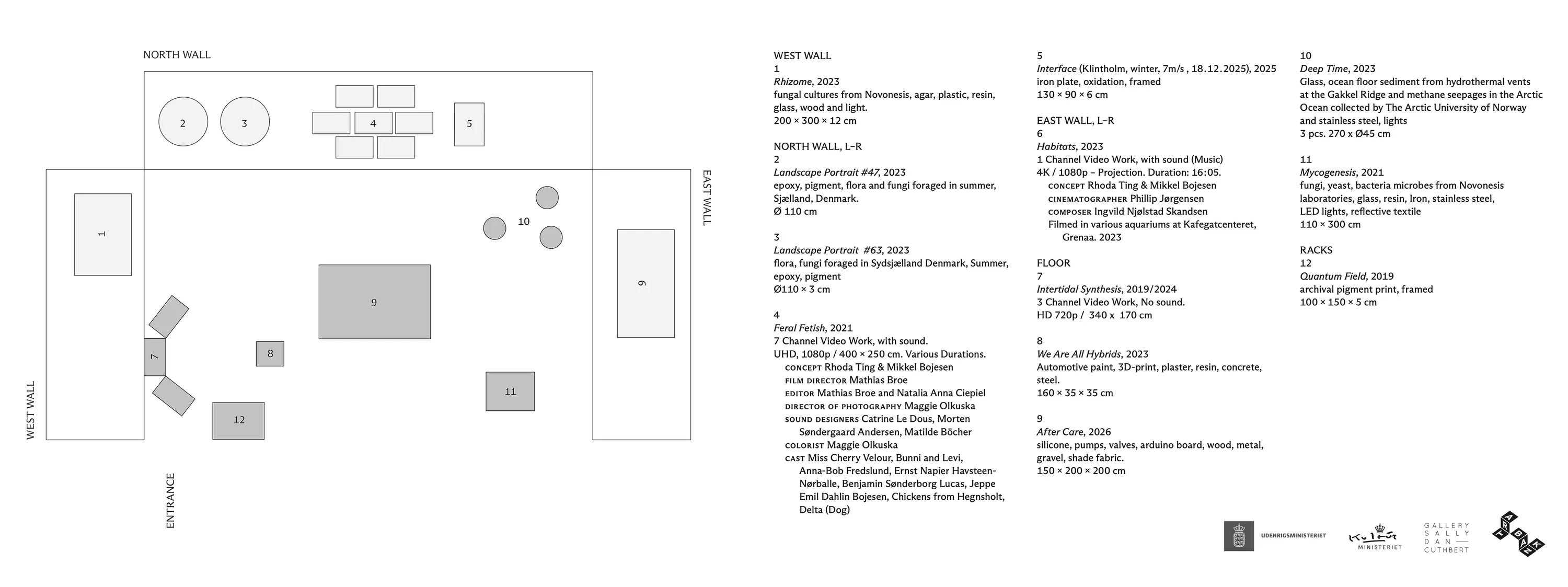
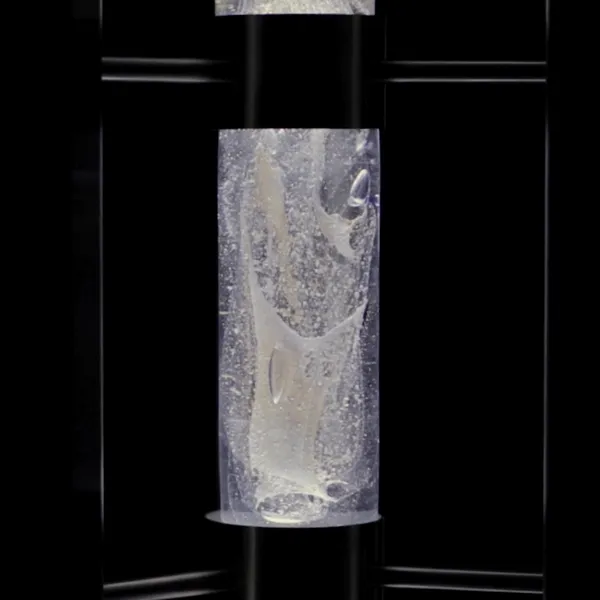
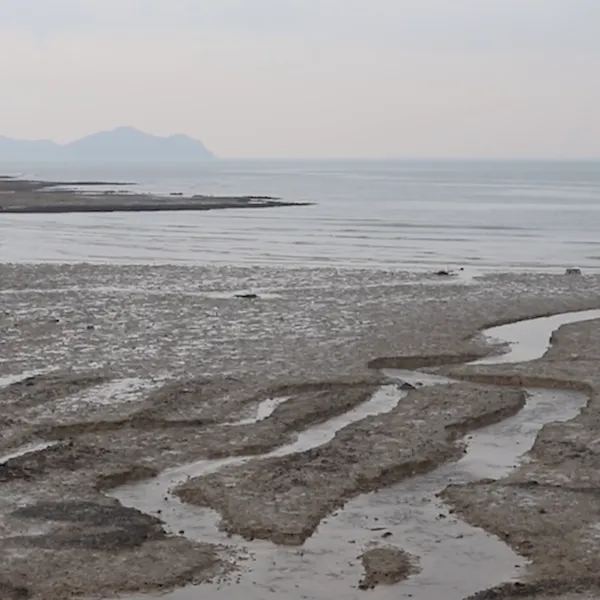
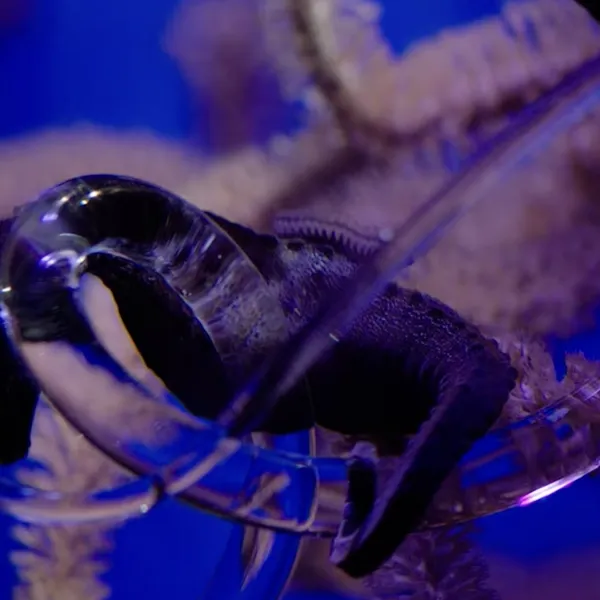
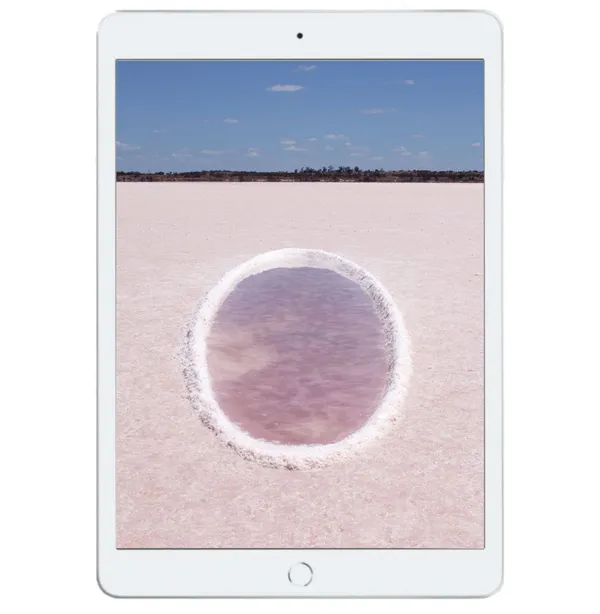
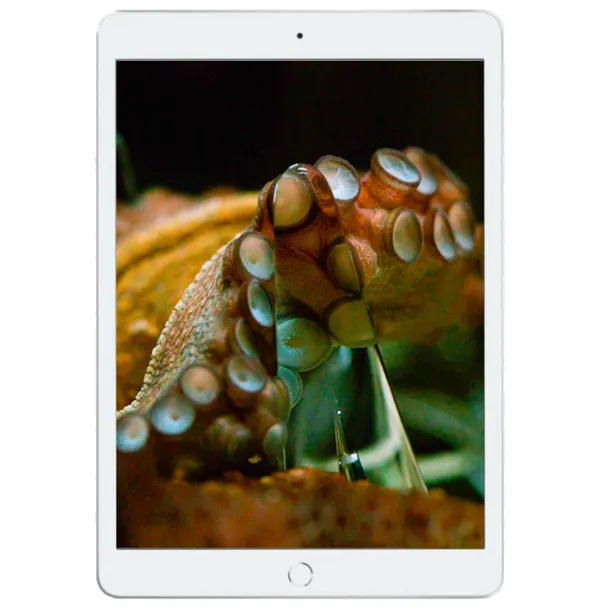
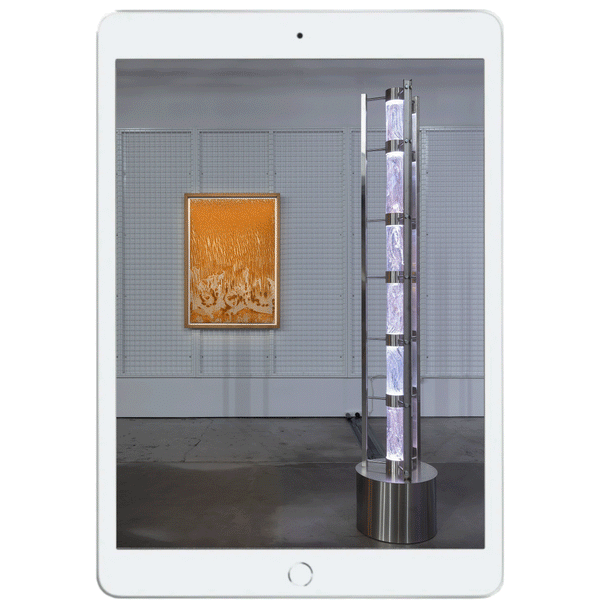
HYBRID FUTURES brings together sculptures, films, and living installations by Australian-Danish artist duo Rhoda Ting & Mikkel Bojesen. The exhibition explores how life emerges and evolves through entanglements between species, technologies, and environments. Developed between Denmark and Australia and informed by research in evolutionary biology, microbiology, and environmental DNA, the works consider how ecological transformation reshapes relationships between humans and other forms of life.Across the exhibition, speculative and observational approaches intertwine, moving between imagined futures and close attention to living processes already unfolding around us. Living systems take shape in MYCOGENESIS and RHIZOME, where fungi, bacteria, and yeast are grown in petri dishes and colonise suspended glass structures resembling brains, seeds, and organs. As branching mycelial networks spread across petri dishes and through sculptural vessels, they reveal forms of communication and growth that challenge anthropocentric ideas of intelligence and cognition.Questions of deep time and invisible ecosystems also surface throughout the exhibition. DEEP TIME presents glass towers containing sediment drawn from Arctic seabeds dating back 12,000 years, fused into molten glass, connecting viewers with life across geological time. MICROBIAL DWELLINGS, first presented at MPavilion, cultivates microbial cultures from local soil inside a large petri dish, making visible the microscopic ecologies often displaced by urban development. Other works focus on adaptation and ecological interaction across fragile environments. The film HABITATS documents marine animals encountering sculptural glass diatoms introduced into their environment, revealing moments of curiosity, adaptation, and cohabitation.In FERAL FETISH, a SCOBY — a Symbiotic Culture of Bacteria and Yeast used to produce kombucha travels through Danish landscapes that appear natural but are shaped by centuries of intensive agriculture. The work exposes tensions between romanticised images of nature and the industrial systems that produce them. Care and coexistence between biological and technological life forms emerge in AFTER CARE, where soft, gently moving robots breathe among red volcanic rocks sourced from Bacchus Marsh in Victoria. Borrowing its title from a term used in BDSM communities describing the practice of tending to one another after intense experience, the work reframes “aftercare” as a speculative ethic of responsibility toward technological life. The robots appear less like devices than companions, suggesting that new forms of care may be required as synthetic life becomesincreasingly present in the world. These robotic forms reappear in INTERTIDAL SYNTHESIS, a three-channel film that places them within coastal environments across Australia, Denmark, South Korea, and China. Set in working shorelines shaped by industry and ecological change, their slow breathing movements blur distinctions between the artificial and the alive.Material transformation is central to the exhibition’s methodology. In the LANDSCAPE PORTRAITS series, organic matter collected from local environments intra-acts with epoxy resin, forming compositions that register ongoing biological and chemical processes. INTERFACE similarly records traces left by oceanic forces on exposed industrial materials such as oxidising metal plates, allowing environmental conditions to act as collaborators in the production of form. The photographic work QUANTUM FIELD documents the artists’ land art composition of reconfigured salt crystals at Lake Crosbie in Murray-Sunset National Park, Australia. The work gives visible form to quantum entanglement, the principle that things once connected remain in relationship across any distance.Several works imagine possible trajectories of evolution and hybrid life. In WE ARE ALL HYBRIDS, a vividly coloured sculptural organism is generated from environmental DNA gathered across multiple species. Algorithmically combined through artificial intelligence, these forms propose speculative organisms that feel both strange and plausible, suggesting that evolution unfolds through continuous exchange rather than isolated development.Taken together, the works propose a shift away from narratives of human control toward an understanding of life as fundamentally relational. HYBRID FUTURES presents a world shaped through processes of collaboration, co-evolution, and multi-species entanglement, where the boundaries between nature and culture, the natural and the synthetic, and the pure and the feral begin to dissolve.HYBRID FUTURES is co-curated by Sofie Dirks Gottlieb (Copenhagen) and Sally Dan-Cuthbert (Sydney).HYBRID FUTURES is supported with funds from a joint grant under the Danish Ministry of Culture and the Ministry of Foreign Affairs of Denmark.
-

-
-
Selected Press
-
Est Living, Design Now | The Latest from USM, Gallery Sally Dan-Cuthbert and More
Rhoda Ting & Mikkel Bojesen March 20, 2026Each week, we highlight a selection of global design headlines, from standout projects to innovative product launches and industry moments. Celebrating craftsmanship, creativity and contemporary design, we explore this week’s... -
Belle Friday Fabulous 5 - Rhoda Ting & Mikkel Bojesen
Rhoda Ting & Mikkel Bojesen March 20, 2026Site specific sculpture Lake Crosbie Pink Salt Lake, Murray-Sunset National Park, North West Victoria, Australia Reconfiguration of Salt, 11 x 3 meters. Printed work, Documentation. 2019 -
Artbank acquisition of ‘HABITATS,’ 2023
RHODA TING & MIKKEL BOJESEN March 20, 2026Artbank is pleased to announce the acquisition of ‘HABITATS,’ 2023, by Rhoda Ting & Mikkel Bojesen. 'HABITATS' documents marine animals encountering sculptural glass forms introduced into their environment, which reveals... -
Vault | Hybrid Futures and Soft Power
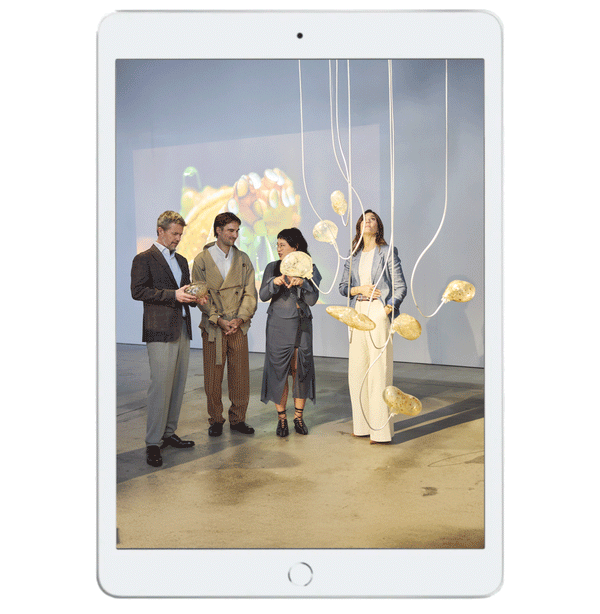
Rhoda Ting and Mikkel Bojesen March 18, 2026A quiet cultural moment unfolded at Artbank in Naarm/Melbourne this week, as His Majesty King Frederik X of Denmark, alongside Australian born Queen Mary, officially opened Hybrid Futures , a...
-
Rhoda Ting & Mikkel Bojesen: Hybrid Futures
Current viewing_room