
Their Majesties King Frederik X and Queen Mary of Denmark officially open HYBRID FUTURES at Artbank in Melbourne. As the debut solo exhibition for artists Rhoda Ting and Mikkel Bojesen, also a Danish-Australian duo, the exhibition is co-curated by Copenhagen-based Sofie Dirks Gottlieb and Sydney-based Sally Dan-Cuthbert.
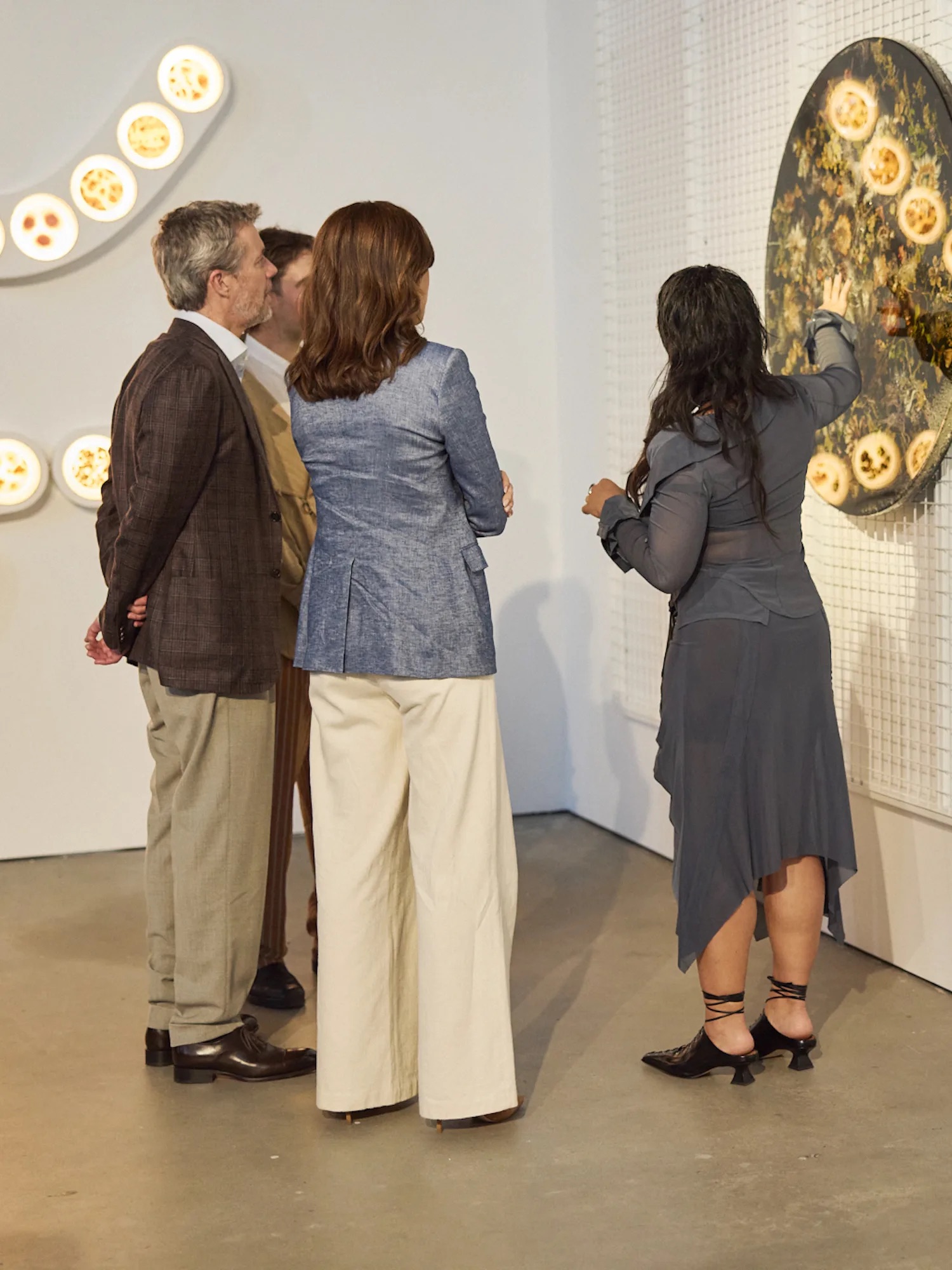
Mikkel Bojesen: Thank you—and thank you for coming to see the show. The opportunity began with a rather cryptic call from the Ministry in late November 2025. They were planning a high-level visit to Australia, celebrating Danish-Australian collaborations across nature, industry, and technology, and were seeking artists whose work aligned with those themes.
As an Australian-Danish artist duo—with Rhoda having grown up in Melbourne—we happened to sit at that intersection. We were incredibly honoured to be invited. It became even more special when we learned the exhibition would form part of Their Majesties King Frederik X and Queen Mary of Denmark’s state visit to Australia. Having them open the exhibition and tour the works with us was a truly memorable experience.
Hosted by Artbank, how did collaborating with co-curators Sofie Dirks Gottlieb and Sally Dan-Cuthbert shape the development and presentation of the works?
Rhoda Ting: Sofie and Sally were absolutely integral to both the realisation and success of the exhibition. The project was ambitious, and coordinating an international exhibition of this scale—particularly one involving major institutions and the Danish Royal House—requires a level of logistical and diplomatic expertise that extends far beyond the studio.
Sofie, based in Copenhagen, was instrumental in bridging communication with the Ministry and ensuring alignment between all parties, ensuring the artistic quality was uncompromised. Sally, based in Sydney, brought a deep knowledge of Australian art, which was crucial to anchoring the exhibition in a local context. As part of Gallery Sally Dan-Cuthbert’s stable of artists, this early survey exhibition was a significant opportunity to share the breadth of our practice.
Curatorially, their contribution was equally vital. As this is both our Australian debut and an early survey of our practice, they helped curate a selection of works that speak to one another while articulating the breadth of our ideas. They also wove together what can appear as a wide-ranging body of work into a cohesive narrative, with text that clearly communicates the philosophical threads underpinning the exhibition.
HYBRID FUTURES combines scientific research with reverence for the natural world, while confronting environmental shifts and technological acceleration. Can you share examples of how these themes appear across the works?
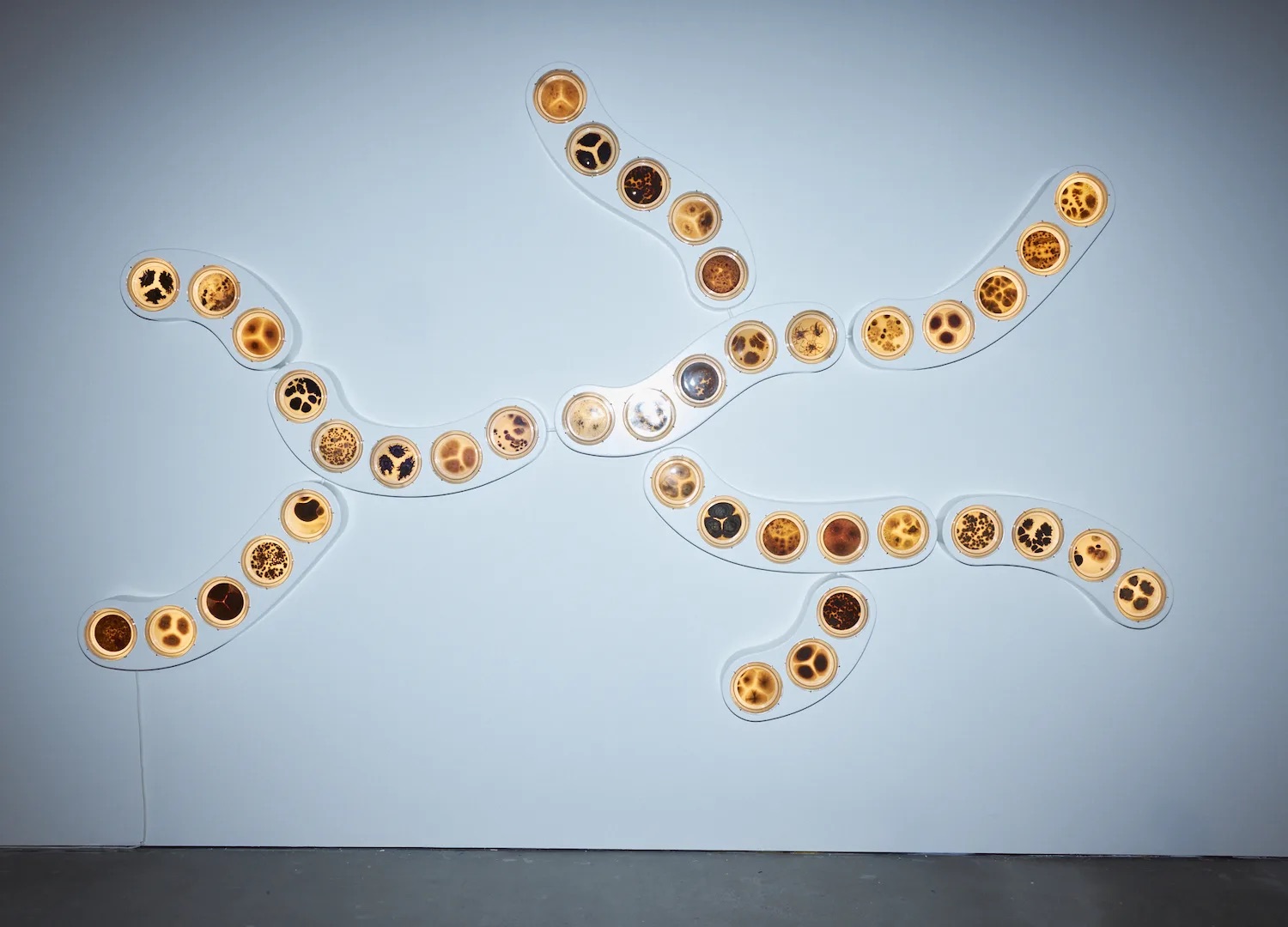
Mikkel Bojesen: Our practice is deeply collaborative. We work with scientists—including evolutionary biologists, mycologists, geologists, and engineers—whose knowledge expands our understanding of and relationship to other species, ecosystems, and technologies. These collaborations allow us to approach the world through multiple lenses, guided by ideas such as posthumanism, queer ecology, and quantum entanglement.
In Deep Time, for example, we joined a scientific vessel in the Arctic, where researchers were studying life evolving in extreme environments shaped by climate change. We collected a sediment core containing traces of life dating back 12,000 years. By grinding this material into powder and introducing it into molten glass, unexpected bubbles and colouration emerged—offering an artistic visualisation of dormant organic matter and ancient mineral compositions.
Similarly, We Are All Hybrids developed through collaboration with evolutionary biologists analysing how biodiversity has been impacted by human activity through marine sediments via environmental DNA. Using species data spanning thousands of years, we worked with AI to generate hybridised forms, reflecting the scientific understanding that evolution is deeply relational and that no organism exists in isolation. The use of AI also gestures toward another evolving intelligence—one that mirrors and shapes our own technological future.
Living systems, microbes, and responsive technologies are central to your practice. How do you negotiate between unpredictability and artistic intervention?
Rhoda Ting: This tension sits at the core of our practice. Posthumanism encourages a decentering of the human—not to erase our presence, but to reconsider our role within broader ecological systems. We often work with open-ended processes involving microbes, ocean systems, or robotics, where outcomes are not entirely controllable. Our role becomes one of facilitation rather than authorship—creating conditions for other forms of intelligence to express themselves.
This requires an ongoing sensitivity to when we are guiding a process and when we are imposing on it. Often, when we intervene too heavily, the work feels forced. When we allow space, the results can be unexpectedly generative—reminding us that other systems possess their own forms of creativity and agency. It is a continual practice of letting go, listening, and remaining open to outcomes we could not have predicted.
Having Their Majesties King Frederik X and Queen Mary of Denmark open the exhibition was a remarkable moment. How did that experience feel for you as artists?
Mikkel Bojesen: It felt both surreal and, in some ways, familiar. We had previously worked with Queen Mary on a separate commission, though that connection was independent of this project.
In the lead-up, there was a sense of anticipation and precision in planning their visit. But once they arrived, the atmosphere shifted—their warmth and genuine curiosity created a space of ease and engagement. They asked thoughtful questions, shared their own experiences with scientific exploration and nature, and connected deeply with the works.
There was also something particularly meaningful about the shared Danish-Australian context. Moving between languages and references, we felt a sense of cultural resonance. When King Frederik X remarked, “It is nice to see another Australian-Danish couple do it well,” it felt like a moment of recognition—of both our practice and our shared cultural identity.
How do you hope audiences engage with HYBRID FUTURES? What conversations do you hope it sparks?
Rhoda Ting: We hope audiences spend time with the works to encounter the many species, processes, and intelligences present, and to reflect on how deeply interconnected we are with other forms of life.
At its core, the exhibition is an invitation to imagine affirmative futures—ones in which humans act as generative participants within planetary systems. We hope it encourages conversations around co-evolution, care, and our relationships with both biological and technological beings.
By shifting our perspective on what it means to be human, perhaps we can move beyond narratives of loss and destruction, and instead recognise that new worlds are continually being formed—and that we are part of that process.

